Showing posts with label Energy. Show all posts

Wednesday, March 5, 2008

Peak Natural Gas - Will we go cold?

Natural Gas - Fuel to Transition to Renewable Energy?
Natural gas is a vital source of fuel primarily used for electricity generation and heating in homes. It is also used as a feedstock for many organic compounds used in industry such as methanol and hydrogen. For peak oil optimists, natural gas is described as a possible fuel to help us "transition" from petroleum energy to various forms of renewable energy such as solar, wind, and hydro.

Natural Gas Background
Natural gas is an extremely clean fuel when combusted/burned and has the lowest amount of carbon emissions for any fossil fuel. Despite these advantages, there are many problems that natural gas must overcome. The first is that it is a gas and will only become a liquid at 77K (approximately -320F if we assume it is primarily methane) under atmospheric pressure. This leads to a problem that natural gas has an extremely low volumetric energy density which means that it is difficult to store and ship. We have only been able to transport natural gas because we have built an expensive natural gas pipeline network.

Natural Gas Production Decline
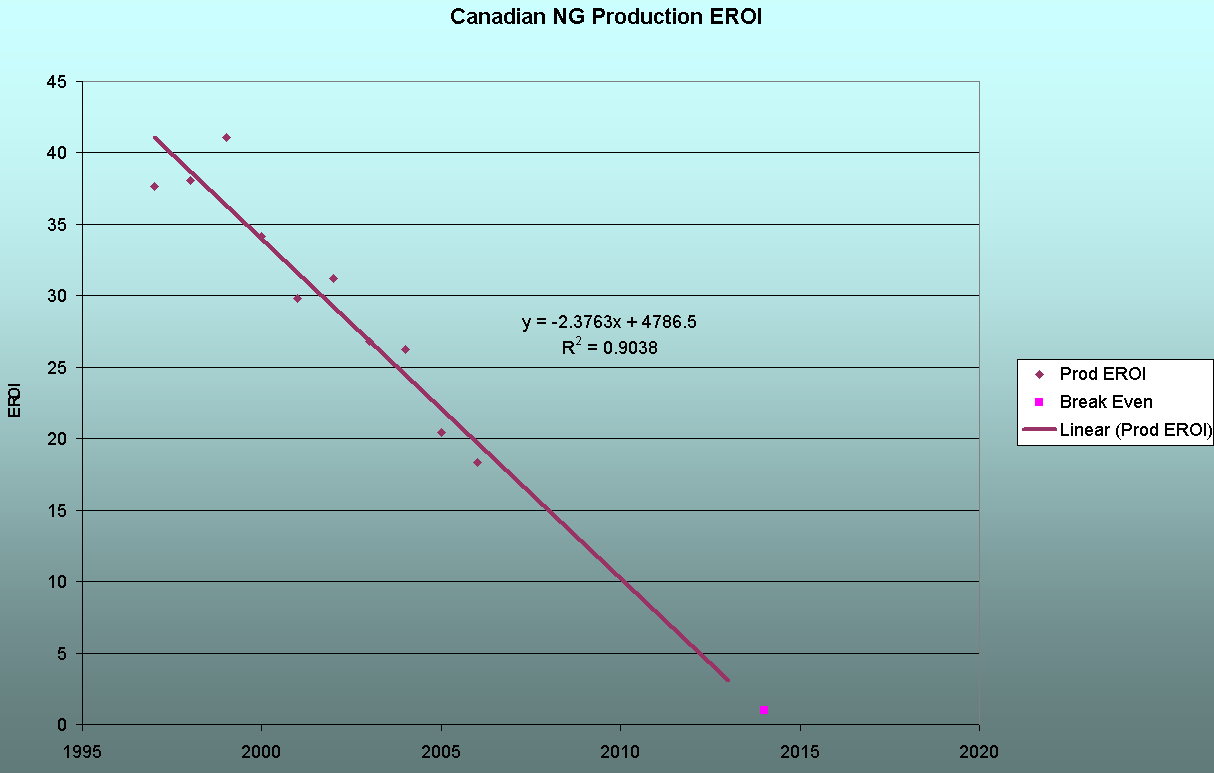
Jon Friese from The Oil Drum recently posted an article titled North American Natural Gas Production and EROI Decline. I could not possibly do the article just by trying to regurgitate the information, especially because the graphs are so vital for understanding the situation we are in. Please see The Oil Drum's article to see the details in depth.

I will state though, that the future of natural gas in the United States and Canada does not look very promising. Based on an extrapolation of the EROI trend line for Canada, it appears that natural gas may not be technically feasible to extract after 2014! This is significantly sooner than the government agencies have predicted based on their reported reserves.

I am always wary of extrapolations. However, I find that the analysis is sound and also looks at historical data to compare trends. It is not exact, but the analysis and extrapolation will give us a good idea where natural gas production is heading. To quote the conclusion of the article:

"The natural gas industry has clearly been mounting a heroic effort to keep natural gas production on plateau in North America. This effort has raised costs dramatically. The EROI of Canadian production shows a rapid decline. Drilling statistics suggest a similar EROI decline is happening in the US. The falling EROI makes it impossible for natural gas production to maintain both low costs and current levels of production. It is clear that most of the reserves in the official forecast will never be developed. Jean Laherrere’s predictions are more likely to be correct. And if EROI continues to fall at the current rapid rate, he will be remembered as an optimist."
EROI - The forgotten statistic
What is EROI? It is an acronym for "Energy Return on Investment". Simply put, it is the amount of energy that a resource has once it is extracted, divided by the amount of energy used to extract it or Available Energy/Input Energy. According to the article, some natural gas fields peak at an EROI of 40:1 but then decline rapidly. See the article's graph for the trend of EROI.

This is particularly worrisome because it shows that the "Break Even" point according to the extrapolation of the trend line is 2014. After this point, it will take more energy input than energy available from the natural gas extracted. This means that it is no longer worth it to extract the natural gas because we spend more energy than we can recovery.

But I thought that the "Market" would solve our problems
Economists from the Chicago Economics school of thought, strongly believe in free market forces. The people believe that peak oil will be a non-issue because alternative forms of energy will become "available" as the price of oil and natural gas increase. This analysis has also been used to argue that we will "never run out of oil" because there will always be oil in the ground. The recoverable reserves are defined as the resources that we can economically extract and the recoverable reserves can increase when prices rise. That is, as prices go up, oil that was previously not economical to recover, will become affordable. Or so the theory goes.

The free market economists fail to recognize the physical and thermodynamic LAWS that NO market can solve. As the price of energy increase, we will afford to dig down further, pump oil further to a certain extent. But there is a limit to the amount of oil we can physically extract. As we dig deeper we expend more energy per unit of energy recovered. Once we approach the "break even" point, it will no longer be rational to extract the oil, no matter what the price is.

It doesn't matter if oil is $1 per barrel, or $1 million per barrel. If we need to use more than one barrel of oil to extract one barrel of oil, it won't happen.

My Thoughts
Just like with petroleum reserves, it appears that government agencies have once again overestimated the true recoverable reserves. They still believe that the "market" will ultimately balance the cost and therefore demand of oil/natural gas (or whatever natural resource is estimated).

However, for as stated above, cost will not be the only factor that will determine the amount of fuel we will be able to be able to extract. The Energy Return on Investment (EROI) will determine the physical limitations to extracting any resource and will ultimately determine the amount that we will be able to recover.

It will be interesting to see whether or not Jon Friese's analysis is correct and that the EROI is indeed in a sharp decline and if we will reach the "break even" point by 2014. If it is indeed correct, we have many problems ahead of us and will not be able to count on natural gas to transition us to renewable energy. Let's hope for the best but prepare for the worst.

Related Blogs:

Related Links:

Recommended Books:

Recommended Movies:

Sunday, February 24, 2008

Peak Oil: Are we on our way down?

The Oil Drum and Peak Oil
The Oil Drum has is a great resource for information related to peak oil and oil production in the world. They have a "Peak Oil" update and the last one was updated in December 2007. It looks at the Energy Information Administration data to plot actual observed production and compares that to the numerous models that have been proposed.

For the figures and data, see The Oil Drum: Peak Oil Update Decmeber 2007. Also, the Peak Oil Update is available in PDF format.

In short, it looks like we have reached the peak for Crude/Condensate (conventional oil), Natural Gas Liquids, and Total Liquids. Convention oil hit a peak in May 2005 and based on the production data from countries around the world, it looks like it will be the "real peak" and conventional oil will never be produced in the same quantities as before.

The peak that we have seen in the past 2-3 years isn't quite the "peak and sharp decline" that many people had predicted, but more of an extended plateau. Regardless of the shape, there is strong evidence which includes the production and price of oil, that we cannot produce any more oil.

Forecasts
What is most alarming, is how off the predictions that CERA (Cambridge Energy Research Associates) and IEA (International Energy Agency) are from the actual observed production. They have been proven to be wrong time and time again, yet the media readily uses them as "reliable" sources (See The Oil Drum's "Peak Oil, IHS Data and The Broken Clock" article for more information).

I think that every person needs to be extremely skeptical of forecasts and press releases by companies and the government on the issue of peak oil. It is one issue that they don't want to touch with a 10-foot pole and if they do they will an unrealistic optimistic view of it.


My Thoughts
The Oil Drum has the most thorough analysis of peak oil that I have found. The analysis and data strongly indicates that we have already passed peak oil and that we are "on the way down". It is disconcerting that the media has shown little if any coverage on the topic. However, whether or not the media likes it, peak oil will happen and it is up to the people to become aware of the situation and inform themselves.

What should we do to prepare ourselves for peak oil? I think that people in Western countries will have an extreme advantage over those in developing countries. We have so much more wealth and we will be able to buy ourselves (at least temporarily) out of the peak oil conditions. However, as crude production continues to decline, the price of goods and the luxuries that we previously have been able to afford will be beyond our means.

In my opinion, the best way to prepare for peak oil is to shift into a lower energy lifestyle. Doing this will let you save money and simultaneously reduce your dependency on oil related products. Because virtually every product in the world is in some way shape or form affected by oil, reducing our consumption will invariably lead to more protection against the looming oil crisis.

Those that will be affected most are those that will not, or cannot, adopt to the new environment of limited oil supplies. Consider reducing your consumption not only for a greener lifestyle, bigger savings, but self preservation. I wish it were not true, but many people will be driven to where they will have to struggle to survive. Preparing today for peak oil will put you in a much better position for when the effects of peak oil begin to hit you.

Related Blogs:

Related Links:

Recommended Books:

Recommended Movies:

Thursday, February 21, 2008

Adding Values to Your Investment: FTSE 4Good Index

Value and Values?
Wouldn't it be great to add not only value, but VALUES to your investment? Socially responsible investing has been increasing in popularity but has not completely proven itself able to outperform passively managed index funds. However, in principal the idea is good because it will eliminate risk by screening companies on their social responsibility and in theory will reduce investment risks.

The FTSE 4Good Index (pronounced "footsie") is an index which screens companies for socially responsible practices. Like Calvert, Parnassus, and Domini, they have various criteria on defining what "socially responsible" and this will naturally determine which companies will be included in the index. FTSE 4Good is unique in that it creates "challenging yet achievable" standards. But FTSE don't stop there. They constantly increase their standards and any companies that do not meet the standards will be removed from the index.

Vanguard's Socially Responsible Option
Vanguard has a great option with their FTSE Social Index Fund Investor Shares (VFTSX). Briefly, the fund seeks to track the FTSE 4Good Index, is a no load index fund (no sales or redemption fees) and has a low 0.24% expense ratio (for more information see the Fund Snapshot and Fund Prospectus). As I detailed in my blog post Socially Responsible Investing: Can it be traditional funds?, I could not justify investing in the various socially responsible funds because of the high expense ratios and fees.

Luckily, Vanguard offers a more cost effective index fund compared to other available SRI funds. Previously, Vanguard had benchmarked the Calvert Social Fund but switched for a variety of reasons (See Social Fund's article). Vanguard's low cost SRI fund intrigued me and deserved further investigation as an investment option.

FTSE 4Good Overview
For an overview, take a look at the FTSE 4Good Index Brochure and the Inclusion Criteria Brochure. Below I've listed the types of companies that they exclude, and then the factors the fund uses to determine what remaining companies will be included in the fund.

Exclusions

  • Tobacco Producers
  • Companies manufacturing either whole, strategic parts, or platforms for nuclear weapons systems
  • Companies manufacturing whole weapons systems
  • Owners or operators of nuclear power stations
  • Companies involved in the extraction or processing of uranium
Screening factors
  • Working towards environmental sustainability (Climate Change)
  • Developing positive relationships with stakeholders
  • Up-holding and supporting universal human rights
  • Ensuring good supply chain labor standards
  • Countering bribery
Within each of the screening factors there is an myriad of criteria and divided by high/medium/low impact and even identifies specific sub-sectors/industries that have special criteria. For more specifics see FTSE 4Good's Criteria Documents.

What holdings does the index have?
After the exclusions and the rigorous screens and filters that the FTSE has performed there are a few funds that remain. Their holdings can be found here.

I was surprised to see Rio Tinto included. They are a mineral/mining company that has not had the best reputation in the past. Also, it interested me that no oil/petroleum companies are present. Given the circumstances of peak oil and how well these companies are performing, I feel like it is not wise to exclude these companies.

This is where socially responsible investing can get extremely difficult, because there are a set of criteria and if a company doesn't meet them, they are not included. Although I want to believe that there are rational people determining the criteria that these companies should have, it worries me that emotions might get in the way of investing. I personally would never bet against any energy companies, in particular petroleum because they are so integral to our society and will only make more once peak oil hits.

My Thoughts
This index is relatively new and there isn't much performance history. However, I have to say that they have an extensive and rigorous set of criteria to select socially responsible funds. I want to believe that these screens will provide the investor with a superior profile but I am reluctant to do so because it eliminates a significant amount of the market. Burton Malkiel's book "A Random Walk Down Wall Street" and the book "The Bogleheads' Guide to Investing" give very strong evidence that it is extremely difficult to beat the market. Many active fund managers choose to instead track the market with low cost index funds for their own portfolios.

I think that once I get a larger amount of assets, I will look towards adding socially responsible investing as a small portion of it. Before that though, my investments will go primarily into the Target 2040 Retirement Fund which automatically diversifies your investments and will change them to more conservative investments as you approach your retirement. Target Retirement funds represents a much broader market profile and does not involve as many risks as an index fund like the FTSE 4Good Index. The Target Retirement 2040 fund is comprised of other "staple" Vanguard index funds which are seen below:
  1. Total Stock Market - 72.0%
  2. Total Bond Market - 10.1%
  3. European Stock - 9.9
  4. Pacific Stock - 4.4%
  5. Emerging Markets - 3.6
This ratio of stock/bond/foreign is typical of an investor of my age. As I grow older the portfolio will shift towards a higher percentage of bonds for reduced risks. I see these retirement funds as a great way for beginning investors to get a broad mix of investments.

The second major part of my portfolio will involve California Long Term and Intermediate Term Tax Exempt funds. These funds have California Muni Bonds which are "triple tax free". This means they are not subject to Federal, State, or Local income taxes. For me that is extremely important because of my high federal and California state income tax brackets.

Once I have a substantial amount invested into the Target Retirement and Tax Exempt Muni funds, I will begin investing in the socially responsible funds. At the moment I plan to invest 10-15% of my portfolio into SRI funds. If there is strong evidence in the future that SRI funds can outperform traditional funds, I will consider investing more into SRI specific funds. However, until then, I will stick with a more traditional strategy with a 80/20 mix of stocks/bonds with some money in munis.


Related Blogs:

Related Links:
Recommended Books:

Tuesday, February 19, 2008

Recycling: Does it make a difference?

In most urban cities, recycling bins are abundant and are found in most public buildings. Recycling is considered the right thing to do for the environment. But is recycling really what we should be doing, or is it a stepping stone towards something greater?

We are Living in a Material World

Different end products require different amounts of energy and processing to recycle a product. Certain materials such as aluminum have definite advantages when recycled. The energy to recycle aluminum is 95% less than creating it from raw materials. However, for products like paper, plastic, and glass, it is not necessarily advantageous to recycle the product.

One reason is that the energy and cost to collect and transport the recyclable can be greater than the cost and energy to manufacture the product from raw materials. This of course is partially due to the fact that most environmental costs today are externalized, and the cost of harvesting virgin materials is vastly below the true cost.

However, we must work within the societal and political framework that we currently live in. It means that sometimes it is not economical to transport heavy glass bottles to be recycled when we are able to produce it from raw materials for less.

Location, location, location

The largest factor outside of the material that is recycled is where you are trying to recycle. The first aspect of recycling location is the population density of a given city/town. If there is a high density of people, it means that collection trucks are more efficient and use less energy for transportation per unit mass of recycled material.

The second aspect of location is amount of land available for landfills and how far away from the recyclers it is. Rural areas have access to cheaper land and are able to cheaply discard their otherwise recyclable products. Location is a strong factor in the recycling equation and will ultimately influence the economics of recycling.

The Three R's: Reduce, Reuse, Recycle

When most people talk about being environmentally friendly, they will typically look at recycling as a key indicator of "being green". However, this is the wrong approach because there are many other things that are much more efficient than recycling.

In Germany and other countries, they use higher density PET (polyethylene terephthalate) bottles which can be refilled up to 20 times. The bottles only have to be collected and sanitized before resuse and don't need to be crushed, heated, and reformed for use.

There is a reason that the Three R's are arranged in the order of "Reduce, Reuse, Recycle". Reusing is more important than recycling, and reducing is the best way to be "green". However, unless you are willing to completely withdraw from the consumer society that we are living in, it will be impossible to reduce your impact to nothing. The only way we can "eliminate" our environmental impact is to rethink the way we make things.

Cradle to Grave Paradigm
There is a fundamental problem with recycling. We continue to follow the "Cradle to Grave" paradigm. Yes, we are finding more uses for a product and extending it's life, but in the end it WILL end up in a landfill.

When materials are recycled, the quality (purity, or usefulness) of the product decreases to the point where it eventually must be discarded. One example is pulp fibers. When paper or any pulp products get recycled, the pulp fibers get smaller after each time it is recycled until they are no longer usable and are either burned for energy or sent to a landfill.

Recycling products can be seen as treating the symptoms of a problem, where the actual cause is not being addressed. The only way to solve our problems is to redesign our processes to be "Cradle to Cradle" and in sync with the ecological cycles. Our products should be designed such that the "waste" streams should be the nutrients and input to another system, whether it is the ecosystem or a man-made system. If, and only if, we are able to redesign our products to be "Cradle to Cradle", will we truly be a sustainable society.

My Thoughts
It may seem like I have a negative view about recycling, but in reality I don't. I try to recycle everything that I possible can and I will even carry a can around until I find a recycling bin.

My problem with recycling is that it is not a solution, but instead temporary band-aid to the larger problem. We need to move from a "Cradle to Grave" paradigm towards "Cradle to Cradle". That means that we will have to redesign many (if not ALL) products in our lives so that they will become part of the ecological cycle. (See William McDonough's book Cradle to Cradle)

I encourage all of my readers to continue recycling. But while doing so, think about the other R's. Reuse any products before you recycle them, or better yet, reduce your consumption.

Recommended Books:

Wednesday, February 13, 2008

Biofuels: How "green" are these crops?

The International Herald Tribute has an article titled Studies conclude that biofuels are not so green. This study, along with many other recent criticisms have brought a strong attack against the claim that biofuels are cleaner and will be able to replace a substantial portion of the United States transportation energy needs.

Land-Use
The study by Princeton University includes a factor that is frequently ignored or assumed to be insignificant: land use. The study states:

The clearance of grassland releases 93 times the amount of greenhouse gas that would be saved by the fuel made annually on that land, said Joseph Fargione, the lead author of the other study and a scientist at the Nature Conservancy. "So for the next 93 years, you're making climate change worse, just at the time when we need to be bringing down carbon emissions."
According to this study, land use is an important factor. Once it is taken into account, it is apparent that at least from a greenhouse gas emission perspective biofuels are not better than conventional fuels, but in fact worse.

Life-Cycle Analysis

The problem with any environmental studies is that they have to make assumptions. This is necessary in sciences where it is simply not possible to measure everything. Most scientists or engineers have to make assumptions at some point but the validity of the assumption can often be questionable. Previous studies did not include land use into the study and apparently missed a large portion of the emissions.

My Thoughts
My primary reason for studying Chemical Engineering was alternative and renewable energy such as hydrogen fuel cells and biofuels. However I quickly realized that these will not be able to replace conventional fuel.

When you look at the economics and the engineering behind it there are many reasons why alternative fuels will not be able to quickly (if ever) displace a significant portion of conventional fuels. The most important factor in determining whether or not a fuel is viable, or in the case of transportation critical, is it's energy density. Simply put, it is how much energy per unit mass or unit volume. See the Wikipedia article on Energy Density.

Conventional fuels such as coal or petroleum products have been used because they have a high energy density and can be transported efficiently. If fuel is grown, it is in extremely low density and must be changed into higher quality fuel. Some studies even show that ethanol is a net energy loser, meaning that it needs more energy to produce than energy in the end.

Growing crops for fuel has only been profitable because of the subsidies given to the corn industry and the subsidies for ethanol. Take those away and there is little economic viability. The government needs to stop given subsidies to fuel "sources" that are not viable and start focusing on conservation efforts and investing in infrastructure for lower energy intensity lifestyles.

There isn't one technology that is going to save us for the upcoming energy crisis and we should be skeptical of anyone promising us a miracle fuel. Let's focus on the principals of sustainability and consuming less to get us through peak oil.

Related Blogs:

Recommended Books:

Recommended Movies:

Monday, January 28, 2008

Energyville Part II: The Discussion

Energyville Discussion
When I played the game on January 20th, there were 504 posts. Some of the posters were very knowledgeable and proposed certain solutions that will help with energy supply. For example one user talked about using waste heat for combined cycles and co-generation. Another talked about reducing the amount that we use instead of striving for eternal growth. In my opinion, this is what will happen, whether it is voluntarily or forced due to energy decreases resulting from peak oil.
However, not all of the comments were intelligent and I would like to highlight a few.

Popular Science and God
The next quote is from one of the posts in the Will You Join Us Discussion Forum:

"There are so many innovative products cited in POPULAR SCIENCE every issue for the past two years...can't we tap into some of those now? It seems to me that God is providing many new resources to help us through such emergency times...they need to go into mass production while we are able to do so."
The first thing that concerns me is that he believes everything in Popular Science. My biggest problem with Popular Science is that they look at "emerging" technology that is often not commercially or even technically proven. It is definitely great material for a curious reader to think that these technologies are on the cusp of being realized, but in reality, most of these ideas are years down the road or won't ever be developed.

For example in this article, The Two Day Battery, from Popular Science, the author reports that scientists have discovered a way to make batteries last longer, going from 4 to 40 hours. Those who aren't skeptical probably think that it's just around the corner, but the author of the article makes the following concession his last sentence:
"Of course, this is still in the lab stage, and there are undoubtedly quite a few steps and hurdles between the campus and commercialization, but we're optimists."
I hate to be a Debbie Downer, but we do not have the time or the resources to be optimists. We can't hope for the next emerging technology to magically save us. We need to be REALISTS and understand the the current problems and the current (however incomplete they may be) solutions that exist and begin to implement them.

My second concern is relating to god. If we are relying on god to provide us with energy then I think we have a rocky road ahead. I think it is highly unrealistic to hope for divine intervention when the laws of thermodynamics and physics are at work.

What the !@#& are you thinking?
The user who commented above might have some issues with what the next person has to say about creating mechanical life to use it to provide energy. (Disclaimer:the quote below has NOT been modified in any manner from the original text)
"perhaps genetically modified biomechanical , half creature half mechanical,feeding it neutritous water could produce a sercetion to then power the mechanical part. Is this possible yet or do we not no about it yet?"
Spelling and grammar aside, there are significant problems with the ideas the person presents. Where would we get this "neutritous water"? Assuming there is an ample supply of "neutritious water", does the reader not understand that much of the caloric value of this water would be used in the biological process and less energy is available in the secretion than there was originally?

What I think, is that many people don't realize that energy just can't be extracted from anything. There are only certain sources of matter or energy in this world and universe that are useful and can be economically harnessed.

My Thoughts
I think that The Economist Group has focused on the wrong issue. They continue to work with the idea that we must continually provide more energy for mankind. However, thermodynamic laws and supply sets limits. I will admit that increased efficiencies and new technologies will provide some "free" energy that was previously not harvested due to inefficiencies.

But the overall picture is that we are already consuming more energy than is sustainable. As China and other developing countries continue to industrialize and copy the Western high-energy lifestyle, the pressure on energy supply and the environment will be even greater.

The reader who had a comment on Popular Science and God did have one nugget of wisdom: "
...they need to go into mass production while we are able to do so." We must begin to acting today while we still have cheaper fossil fuels. Once peak oil hits, we will not have the extra energy to spend on infrastructure.

What Can You Do?
The Energyville game and discussion forums offer a great starting platform for learning more about energy. The game does a pretty good job of discussing the pros/cons of each energy and what technical or economical limitations may exist.

As always, education is the key. Educate yourself and your friends about the issues. We can't start making changes in this world until we know what needs to be changed.

Related Blogs:

Related Links:

Recommended Books:

Recommended Movies:

Saturday, January 26, 2008

Shell Energy CEO Virtually Admits to Peak Oil

Two Paths: Which will we choose?
Shell CEO Jeroen van der Veer released an article which outlines the future of energy. He proposes that there are two paths that we can take. He titles one "Scramble" which is similar to how nations react to resource scarcity as described by Resource Wars by Michael Klare. This is the scenario in which nations will go to war over the resources remaining in the world. (See how the video game "Fuel of War" depicts the "Scramble" scenario in this blog).

The second path he calls "Blueprints" which is similar to Richard Heinberg's scenario "Powerdown: The path of self-limitation, cooperation, and sharing" as described in his book PowerDown. This scenario is one in which the nations will have to cooperate and set policies to use the resources to the benefit of the most people and avoid resource wars.

van Der Veer states the following opinion on which path that Shell, America, and the world should take:

"Shell traditionally uses its scenarios to prepare for the future without expressing a preference for one over another. But, faced with the need to manage climate risk for our investors and our descendants, we believe the Blueprints outcomes provide the best balance between economy, energy, and environment."
I believe that pretty much everyone would agree that going to war over resources is not a path that we should embark (or continue) on, and that we should look towards a future filled with cooperation and sustainability.

Peak Oil
The most powerful part of van der Veer's article was the following paragraph which is practically an admission to the existence and tremendous importance of peak oil.
"Regardless of which route we choose, the world’s current predicament limits our room to maneuver. We are experiencing a step-change in the growth rate of energy demand due to rising population and economic development. After 2015, easily accessible supplies of oil and gas probably will no longer keep up with demand." (Emphasis added)
These are extremely strong words for a CEO of a company that depends on selling these "easily accessible supplies of oil and gas". It would be similar to Starbucks saying "After 2015, cheap supplies of coffee probably will no longer keep up with demand". Simply stated, this is something that would not be said unless the company was truly concerned about the issue.

This marks the first time that anyone from a major energy company has openly admitted that peak oil will happen before 2020. Although there has been a strong, yet mostly underground movement for peak oil, the energy industry has been reluctant to admit that peak oil would even be a problem... until now.

My Thoughts
I am truly amazed that someone has finally stepped up to the plate and recognized the need for a drastic change. Jeroen van der Veer admits to "peak oil" without explicitly saying those words and recognizes the need for drastic change to ensure that we do not go down the path of Scramble, plunging ourselves into a never-ending resource war until there is only the "Last Man is Standing".

I must congratulate him for making such a bold statement to the public in light of what shareholders may think. However, as he stated, climate risk must be managed by balancing economy, energy, and environment. It is in the shareholder's and our descendant's best interest that we look at energy and greenhouse gas emissions and work to find a sustainable solution.

I can only hope that politicians and other leaders of corporations will follow Jeroen van der Veer's footsteps and confront reality. We cannot address the problem if we are not aware of . Once we have admitted that we have a problem, we can begin to work on fixing it.

Related Blogs:

Related Links:

Recommended Books:

Recommended Movies:

Wednesday, January 23, 2008

Energyville: Part I - How will you power it?

Energyville Overview
Energyville is a game developed by The Economist Group for Chevron to look at providing energy to a city using various resources. A game that is based on something as intricate as the world energy supply will no doubt have some major assumptions. I've quoted parts of the disclaimer for the game below.

... Assumptions for the game, both present and future, are based on The Economist Intelligence Unit’s assessment of global facts and trends obtained from numerous credible sources... The game has limitations and many elements have been simplified to facilitate game play... Additionally, although you are able to determine how to power your city, the game does not take into account the time and investment needed to replace exiting energy infrastructure with your choices.
Even the best modelers in the world still have difficulties forecasting because there are so many different factors that will affect a global market. However, for the purpose of the game, these have been simplified and many assumptions have been made to make the game work.

This is your city. How will you power it?
The game lasts two rounds with the years between 2007-2015 and 2015-2030. Your city has various energy needs and you must supply enough energy using different sources. Each energy source has been evaluated on three impacts: economic, environment, and security. Simply put, the lower your impact of your city, the higher your score.

The economic and environment impacts are a given because they are typically discussed in the media. "How much will it cost compared to conventional fuel/energy" and "How much CO2 does it emit compared to conventional fuel/energy" are the typical questions that need to be addressed.

Also, I understand the importance of security related to being able to protect the infrastructure and having a reliable source. This is extremely important for the United States because much of our energy (oil/petroleum in particular) is imported and there is a risk associated with not being able to supply your own energy.

However there is one factor which is often forgotten, the "social" impact. At the Earth Summit in Rio De Janeiro in 1992, leaders from around the world discuss sustainable development and determined that there were three factors that must be taken into account: economic, environment, and social. A diagram of how these three factors interact can be seen in the figure below.

Source: http://www.eoearth.org/image/Sustainable_development_triangle.gif

Unfortunately corporations are forced by their charter to focus on the economic. The only way that a corporation can focus on the others, is if they will make an impact on the bottom line. (See The Corporation for more information about what corporations are and how they work). Recently more attention has been focused on the environmental aspect and corporations are changing their practices to include some environmental impacts (again, only to increase the branding of their company and to improve their economic sustainability).

It is unfortunate that the social aspect has been left out, but nonetheless I have compiled all of the impact values for the game in the table below.


Petroleum is by far the worst (I wonder how much input Chevron had into this game) at a total of 22% and hydro power is better than all of the rest at 8% (if we can assume that all impacts can be weighted equally). I believe that most of the numbers are relatively accurate of the impact with the exception of the economic impact of nuclear. It is rated as the second cheapest option (tied with coal).

Although I don't have access to the data that they use to calculate the impacts, I assuming that the data is only looking at the operational costs of nuclear power and doesn't take into account the huge subsidies that the government has to provide to dispose the radioactive waste. If the true cost of nuclear power was known, I don't think it would rate as well as coal in terms of economic impact.

Powering Your City
In both rounds the user has to power up their city by selecting a portfolio of energy sources. To mix things up, two random events occur between each of the game rounds which will affect your city based on what energy sources you have chosen. For example, international conflicts will cause the economic and security impacts of petroleum/oil plants to increase, thus decreasing your score.

There are limitations to your energy sources and you cannot just build unlimited hydro plants. Also, one point that I thought the game represented very well was the types of energy that were needed. For most of the city, electricity is generated centrally and sent through the grid. However, there are sectors such as transportation that are reliant on petroleum/oil. If you build only energy sources that can only be used for stationary electricity generation you will get the following message:
Warning! Hungville requires petroleum. Though alternative fuels can reduce the need for petroleum, airplanes and significant portions of ground vehicles will continue to rely on petroleum for fuel.
I am glad that they did not gloss over this fact because oil accounts for approximately 96% of the energy needed for transportation with biofuels and natural gas providing most of the remaining 4% with approximately 2% each (Data from the Department of Energy: Annual Energy Review 2006).

How Did I Do?
Playing it 5-6 times I got consistently in the top 5-15% scores. Best score was 688,061,046 which was in the top 3.5%. It is merely about making the least amount of impact and you can do this by looking at the numbers that are given. I think a lot of the players didn't look at the impact of each energy source (about 6% of the energy chosen was hydrogen and oil shales, which based on the data the game gave you, is a terrible choice).

I suspect that the top scores are from people who heavily favor the technologies that present the lowest % gain, and they play it enough such that their technologies aren't affected negatively in the random events.

Rating the game
Overall the game play is pretty bland. All you need to do is pick hydro, wind, and some petroleum in the first round. The second round you pick some more wind/hydro/solar because it has become more efficient. Rinse and repeat and you'll be in the top 10% of the scores out there.

That said, the game offers a wealth of information about each of the different energy sources. Even if the information may be incomplete or is biased towards particular energy sources, the game at least brings the awareness of energy issues and serves as a starting platform for people to learn more.

However, it's not all just fun and games and at the end of the game it is possible for the player to then click on a link to go to the discussion forum. In my second blog about Energyville, I address some of the discussion which is occurring in the forum and offer some of my own thoughts and opinions about energy.

Related Blogs:

Related Links:

Recommended Books:

Recommended Movies: