Showing posts with label Environment. Show all posts

Tuesday, March 18, 2008

Garbage Land: On the Secret Trail of Trash - Book Review

As a follow up to my blog Recycling: Does it Make a Difference, I decided to take a look at Elizabeth Royte's book Garbage Land: On the Secret Trail of Trash. I wanted to get a broad picture of what our garbage is and what happens to it. Royte offers an adventure (albeit somewhat sensationalized) of tracking all forms of waste from her household to the collection trucks, the various sorting facilities, and eventually to the dump.

Tracking the Garbage
Royte embarks on a mission to sort, categorize, and weigh all of the trash that her household (her husband and one child) for an entire year. In the process, she follows her recyclables, compost-able materials, hazardous materials (e.g. TV's and computers), sewage, and her garbage to the places where they are either turned into new products or landfilled.

She visits any site where she is allowed access (and to some that don't) to document a process that starts at the household. Most Americans don't give a thought to their garbage besides when the day it is picked up and making sure that they don't miss it. However, Royte seeks to describe how various waste streams make their way around the world.

She does a thorough job at covering the major waste streams in a Western society and looks at the economics and environmental impacts of each often uncovering the good and bad of waste and even something as seemingly innocuous as recycling.

The Ugly Side of Recycling
Recycling has become pretty synonymous with being a liberal environmentalist trying to save the world. However, to the surprise of many, recycling may not be as benign as one may think. We see nice happy stories like Nike creating basketball courts from used shoes and we get to buy post-consumer recycled paper. Recycling only extends the life span on these products but they are only making a brief pit stop before eventually heading to the landfill.

The most insidious "recycling" is probably that of e-waste. Electronics have many precious metals like gold and copper in the circuit boards. But environmental regulations and the high cost of labor in America makes it uneconomical to extract these metals (it is cheaper to just buy virgin materials from mines).

Thus, the electronics get shipped on container ships from the United States to China (which would otherwise be empty because of the tremendous import/export imbalance). It is economical because the cost of labor and environmental regulations in China are significantly lower than in the United States

In China, villagers will use chemicals such as cyanide to leach gold from the electronics and are exposed to many other chemicals such as mercury from monitors and lead solder. We think that we are helping othe world by recycling our electronic goods, but in reality we are pushing the environmental and health costs to third world nations willing to recover these materials. See the Basel Action Network (BAN) Photogallery and Digital Dump Trailer for more information.

Zero Waste
In the last few chapters Royte discusses the possibility of a world with "Zero Waste". Despite her recycling habits and her attempt to reduce as much waste as possible, she still ended up disposing of approximately 4.65 pounds of trash per week (which is 19.5 times lower per person than the national average according to an EPA statistic).

The fundamental problem is that we have externalized the costs of waste and pollution and therefore the costs to dispose of items costs much less than the damage that is done to the environment (this is measured by the amount it would cost to replace or restore the natural function that an environment previously had). The only real solution towards creating a truly sustainable society is to design the goods we used to not produce any waste.

Virtually all products sold today are designed with a Cradle to Grave philosophy: it will eventually find its way into a landfill. However, William McDonough proposes in his book, Cradle to Cradle: Remaking the Way We Make Things, that we need to design our products such that the "waste" products will be the "nutrients" for another system, whether that is natural or created by man. Only then will we be able to live with "Zero Waste".

My Thoughts
Garbage Land is a great primer for people who are unfamiliar with the recycling and garbage industry. My main criticism is that it feels more of an adventure rather than a scientific paper with strong supported facts and evidence. At one point she said the methane "smelled like rotten eggs". Methane gas is actually odorless and is the main component in natural gas. However, mercaptans (sulfur based molecule) are added to natural gas to give it the "rotten egg" smell. I was upset that she couldlet a fairly well known fact slip through.

After reading this book I was reminded at a slogan that was on a paper towel dispenser in a bathroom at my office which simply has the words:

"Green is using only what you need"

I think that this sentence pretty much sums up sustainability and the conclusions reached in Garbage Land. It isn't about buying a green product just because it is available. It means reducing your consumption, and if no other options are available, then try your best to buy an eco-friendly product. We need to reduce our consumption of products, especially those that are designed to be disposable.

Although the amount of waste produced from municipalities seems tremendous, it does not clearly convey the amount of waste that was generated to make the products that eventually end up in landfills. According to Paul Hawken, author of Natural Capitalism and the The Ecology of Commerce, for every 100 pounds of product that is sold, at least 3,200 pounds of waste was created. McDonough also has a similar statistic that municapial waste is only 5% of the total waste that gets created to produce and deliver your product.

The easiest way to decrease your environmental and save money in the process is to consume less. This way you can get more satisfaction out of the things that you do have and also enjoy some of the simple joys in life.

Related Blogs:
Related Links:
Recommended Books:

Wednesday, March 5, 2008

Peak Natural Gas - Will we go cold?

Natural Gas - Fuel to Transition to Renewable Energy?
Natural gas is a vital source of fuel primarily used for electricity generation and heating in homes. It is also used as a feedstock for many organic compounds used in industry such as methanol and hydrogen. For peak oil optimists, natural gas is described as a possible fuel to help us "transition" from petroleum energy to various forms of renewable energy such as solar, wind, and hydro.

Natural Gas Background
Natural gas is an extremely clean fuel when combusted/burned and has the lowest amount of carbon emissions for any fossil fuel. Despite these advantages, there are many problems that natural gas must overcome. The first is that it is a gas and will only become a liquid at 77K (approximately -320F if we assume it is primarily methane) under atmospheric pressure. This leads to a problem that natural gas has an extremely low volumetric energy density which means that it is difficult to store and ship. We have only been able to transport natural gas because we have built an expensive natural gas pipeline network.

Natural Gas Production Decline
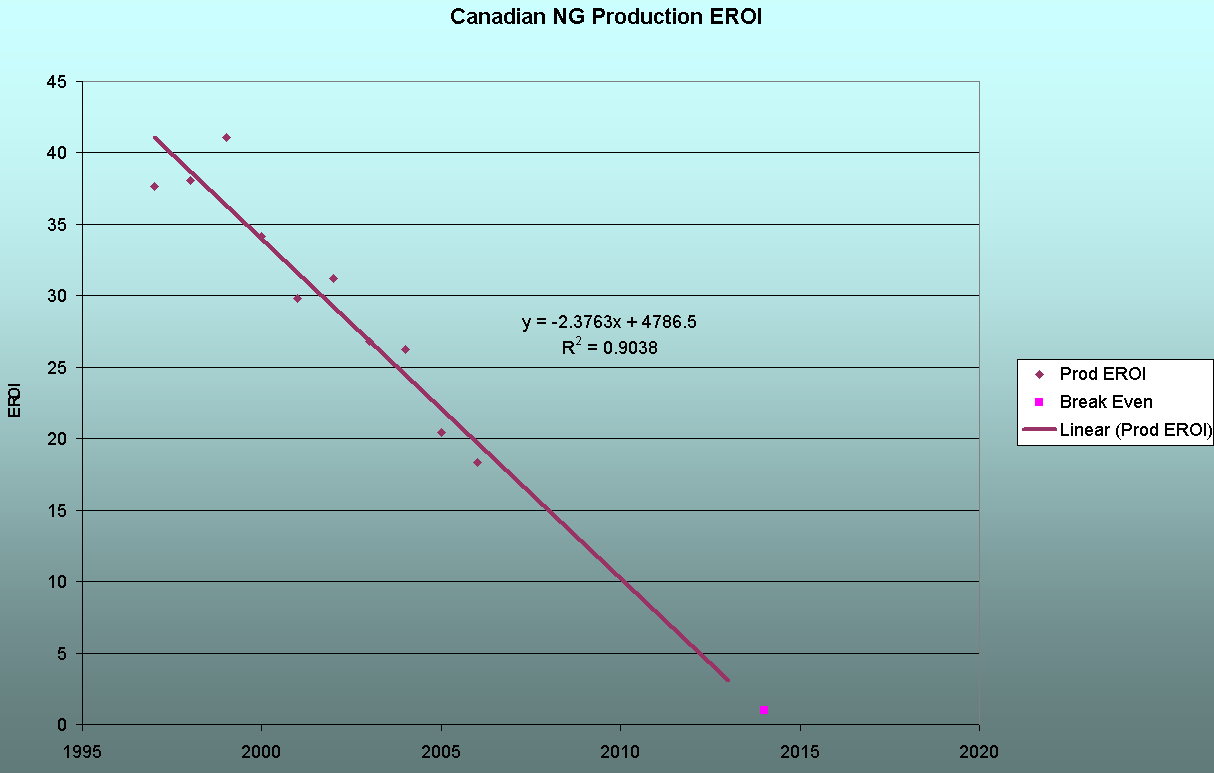
Jon Friese from The Oil Drum recently posted an article titled North American Natural Gas Production and EROI Decline. I could not possibly do the article just by trying to regurgitate the information, especially because the graphs are so vital for understanding the situation we are in. Please see The Oil Drum's article to see the details in depth.

I will state though, that the future of natural gas in the United States and Canada does not look very promising. Based on an extrapolation of the EROI trend line for Canada, it appears that natural gas may not be technically feasible to extract after 2014! This is significantly sooner than the government agencies have predicted based on their reported reserves.

I am always wary of extrapolations. However, I find that the analysis is sound and also looks at historical data to compare trends. It is not exact, but the analysis and extrapolation will give us a good idea where natural gas production is heading. To quote the conclusion of the article:

"The natural gas industry has clearly been mounting a heroic effort to keep natural gas production on plateau in North America. This effort has raised costs dramatically. The EROI of Canadian production shows a rapid decline. Drilling statistics suggest a similar EROI decline is happening in the US. The falling EROI makes it impossible for natural gas production to maintain both low costs and current levels of production. It is clear that most of the reserves in the official forecast will never be developed. Jean Laherrere’s predictions are more likely to be correct. And if EROI continues to fall at the current rapid rate, he will be remembered as an optimist."
EROI - The forgotten statistic
What is EROI? It is an acronym for "Energy Return on Investment". Simply put, it is the amount of energy that a resource has once it is extracted, divided by the amount of energy used to extract it or Available Energy/Input Energy. According to the article, some natural gas fields peak at an EROI of 40:1 but then decline rapidly. See the article's graph for the trend of EROI.

This is particularly worrisome because it shows that the "Break Even" point according to the extrapolation of the trend line is 2014. After this point, it will take more energy input than energy available from the natural gas extracted. This means that it is no longer worth it to extract the natural gas because we spend more energy than we can recovery.

But I thought that the "Market" would solve our problems
Economists from the Chicago Economics school of thought, strongly believe in free market forces. The people believe that peak oil will be a non-issue because alternative forms of energy will become "available" as the price of oil and natural gas increase. This analysis has also been used to argue that we will "never run out of oil" because there will always be oil in the ground. The recoverable reserves are defined as the resources that we can economically extract and the recoverable reserves can increase when prices rise. That is, as prices go up, oil that was previously not economical to recover, will become affordable. Or so the theory goes.

The free market economists fail to recognize the physical and thermodynamic LAWS that NO market can solve. As the price of energy increase, we will afford to dig down further, pump oil further to a certain extent. But there is a limit to the amount of oil we can physically extract. As we dig deeper we expend more energy per unit of energy recovered. Once we approach the "break even" point, it will no longer be rational to extract the oil, no matter what the price is.

It doesn't matter if oil is $1 per barrel, or $1 million per barrel. If we need to use more than one barrel of oil to extract one barrel of oil, it won't happen.

My Thoughts
Just like with petroleum reserves, it appears that government agencies have once again overestimated the true recoverable reserves. They still believe that the "market" will ultimately balance the cost and therefore demand of oil/natural gas (or whatever natural resource is estimated).

However, for as stated above, cost will not be the only factor that will determine the amount of fuel we will be able to be able to extract. The Energy Return on Investment (EROI) will determine the physical limitations to extracting any resource and will ultimately determine the amount that we will be able to recover.

It will be interesting to see whether or not Jon Friese's analysis is correct and that the EROI is indeed in a sharp decline and if we will reach the "break even" point by 2014. If it is indeed correct, we have many problems ahead of us and will not be able to count on natural gas to transition us to renewable energy. Let's hope for the best but prepare for the worst.

Related Blogs:

Related Links:

Recommended Books:

Recommended Movies:

Monday, March 3, 2008

The Pardox of Choice: Why More Is Less - Barry Schwartz - Book Review

Western Civilization has been flooded with so many choices in every aspect of our lives. Whether it is cleaning supplies, college course curriculum, or even finding something as simple as a pair of jeans. We have typically associated choice with an increase of freedom and the ability to steer our life in the direction that we so choose.

However, paradoxically we have become a victim to the plethora of choices out there and it is affecting us psychologically. The extra choices do not liberate us, but instead cause us to agonize over decisions and regret any "bad" purchases that were made.

Barry Schwartz's "The Paradox of Choice" is an excellent book that looks into the choices we make, the psychology of making choices, why we suffer from the choices we make, and lastly, what we can do about choice to live better lives.

Maximizers vs. Satisficers
Barry Schwartz identifies two different types of purchases: Maximizers and Satisficers. The key difference is that maximizers will strive to make the "best" purchase possible, while the satisficers are content with a purchase that is "good enough", which is to say that it meets their basic requirements. Typically maximizers are less satisfied with their purchases and also have more regret. It is okay to be a maximizer when shopping for products that are really important for you. It is only dangerous when you attempt to maximize every aspect of your life.

The Psychology of Choice
Barry Schwartz has a PhD in psychology and gives many psychology examples on how people will make decisions to buy products and their perception of gains and losses. Below, I have outlined a few of the key areas which he mentions that affect our decision to choose. The main purpose of these different factors is that the subjective value can be much different than the objective value. Typically the studies compare things that are equal in objective value, $20 for example, but then see how the different factors change the subjective value.

Accounts
Suppose that you have not yet paid for a concert ticket ($20) but lost a $20 bill the day before the concert. Would you still pay to the concert? What if, instead, you bought a concert ticket for $20, lost it, and had to pay another $20 for the concert ticket?

Although these two scenarios are identical objectively, subjectively they are much different because we tend to filter money different accounts. In the first case, the $20 loss was filed into a "general" account. But for the second scenario, the lost cost was $20 and the "real" cost of the concert ticket would then be $40. In the study that Schwartz cites, over 90% of people would be willing to buy the concert ticket in the first case, yet only 50% would do it in the second case.

Anchors
The idea of an anchor is to create a high price item in the store, a "deluxe" or "luxury" model, and then offer a more standard one. For example, a $100 pair of jeans may seem like a lot, but when compared to $200 pair of jeans, it looks like a bargain. Although not many of the $200 jeans will be sold, they will "anchor" the $100 jean products which leads to higher sales.

Like I wrote in The Dangers of Shopping, it is important to make sure that the purchase is needed and affordable on an absolute scale, not comparing it to the cost of the "high end" or "retail price". Otherwise, we can always justify a purchase as long as it isn't the "most expensive" model out there.

I personally witnessed a shameless example of anchoring at the Guess Factory Outlet store in Vacaville, CA. I asked them if they carried any products from their regular Guess stores and they said "No, the products are made specifically for the Guess Factory Outlet." What really disturbed me was that EVERY price tag had a MSRP (Manufacturer's Suggested Retail Price) and the "discount" price printed on it. Despite the fact that it was made specifically for the outlet, they framed it by posting an artificially high number to make it seem like it was a "bargain".

Gains and Losses

I thought the psychology of loss and gain was the most interesting part of the book and it really sets up the framework for why we agonize over choices. Briefly summarized, we feel more pain for a $100 loss than we feel happiness for a $100 gain. When choosing between a set of choices, there is seldom an option that is superior in every criteria. By not picking the "losing" option, we are giving up a trade off and thus a loss.

The studies explored in the book show that the more choices there are, the more trade offs or "losses" must be taken when making a decision. Because the pain of loss is greater than the happiness in gains, when confronted with too many choices, the buyer/consumer will often not make any decisions. This is true even when it is clear that there is an advantage by picking ANY choice (for example, employers would not pick his/her portfolio of 401(k) funds when there were too many choices, even though they knew they got an employer match).

The Green Factor
Within recent years, environmentalism has become a hot issue in the media and in people's everyday lives. There is now the option to offset your carbon emissions related to electricity use, buy organic produce,

However, by adding these options, it has further multiplied the number of choices that consumers must deal with. What is more important?

  • Greenhouse Gases or aerosols?
  • Organic or local?
  • Water pollution or air pollution?
  • Lower energy uses in CF lightbulbs or no mercury in incandescent light bulbs?
All of these decisions are contributing to a phenomena known as "green fatigue". This is the idea that people are tired from making green and eco-friendly decisions. With so many different factors that can affect the environment, anyone trying to be green must factor these into their purchasing decisions.

Strategies for dealing with choice
In the last chapter of the book, Schwartz suggests multiple ways and details how we can cope with the the abundant choices and making decisions. I have listed his suggestions below.
  1. Choose When to Choose
  2. Be a Chooser, not a Picker
  3. Satisfice More and Maximize Less
  4. Think About the Opportunity Cost of Opportunity Cost
  5. Make Your Decisions Non-Reversible
  6. Practice and "Attitude of Gratitude"
  7. Regret Less
  8. Anticipate Adaptation
  9. Control Expectations
  10. Curtail Social Comparison
  11. Learn to Love Constraints
I plan to create a mini-series and at his suggestions in depth in future blogs. I will say though, that all of the advice seems very practical and is based on the scientific research that has been conducted which looks at the psychology of choice. By simply understand why we act the way we do, we can strongly reduce the negative affects that choice has on our lives.

My Thoughts
I think that this is a great book that has cleared up a lot of things in my life. I am one that is more of a maximizer rather than a satisficer. If I find out that I "could have" saved more money by doing X action, I tend to regret my purchase and am mad that I didn't make the best purchase possible. I will look to follow the steps that Schwartz has recommended, and that I outlined above. I need to be able to not regret my purchases and be happy when I have made a "good enough" purchase.

Although Schwartz suggests that you should worry less about your choices, I believe that it is still important to scrutinize your purchases, especially if it is above your hourly wage (see The Dangers of Shopping). However, it becomes dangerous when the cost of extra scrutiny goes beyond the cost of your time and mental health. The main thing is to "Choose when to choose". This of course will depend on your values and what you think needs to be the "best" and what you can be satisfied with "good enough".

You should only sweat the small stuff if the sweat that you put out is at least equal to the amount of sweat you might get back. An adage that would be appropriate here is "Penny wise, pound foolish". If you look at scrimping pennies on your small purchases, you might be overlooking the larger picture. The time you spend with your penny-pinching could be directed to something that will increase your well being or even make more money.

I really think that reading this book has the potential to make you much happier in life. You will look at life differently and your choices can bring true excitement and happiness. I plan to start a mini-series of blogs related on psychological issues of choice and discuss how just being aware of the psychology of choice can change your outlook and spending on life.

Recommended Books:
The Paradox of Choice: Why More Is Less - Barry Schwartz
GoogleBook: Paradox of Choice (Sample)

Recommended Movies:
Barry Schwartz talk at Google

Sunday, February 24, 2008

Peak Oil: Are we on our way down?

The Oil Drum and Peak Oil
The Oil Drum has is a great resource for information related to peak oil and oil production in the world. They have a "Peak Oil" update and the last one was updated in December 2007. It looks at the Energy Information Administration data to plot actual observed production and compares that to the numerous models that have been proposed.

For the figures and data, see The Oil Drum: Peak Oil Update Decmeber 2007. Also, the Peak Oil Update is available in PDF format.

In short, it looks like we have reached the peak for Crude/Condensate (conventional oil), Natural Gas Liquids, and Total Liquids. Convention oil hit a peak in May 2005 and based on the production data from countries around the world, it looks like it will be the "real peak" and conventional oil will never be produced in the same quantities as before.

The peak that we have seen in the past 2-3 years isn't quite the "peak and sharp decline" that many people had predicted, but more of an extended plateau. Regardless of the shape, there is strong evidence which includes the production and price of oil, that we cannot produce any more oil.

Forecasts
What is most alarming, is how off the predictions that CERA (Cambridge Energy Research Associates) and IEA (International Energy Agency) are from the actual observed production. They have been proven to be wrong time and time again, yet the media readily uses them as "reliable" sources (See The Oil Drum's "Peak Oil, IHS Data and The Broken Clock" article for more information).

I think that every person needs to be extremely skeptical of forecasts and press releases by companies and the government on the issue of peak oil. It is one issue that they don't want to touch with a 10-foot pole and if they do they will an unrealistic optimistic view of it.


My Thoughts
The Oil Drum has the most thorough analysis of peak oil that I have found. The analysis and data strongly indicates that we have already passed peak oil and that we are "on the way down". It is disconcerting that the media has shown little if any coverage on the topic. However, whether or not the media likes it, peak oil will happen and it is up to the people to become aware of the situation and inform themselves.

What should we do to prepare ourselves for peak oil? I think that people in Western countries will have an extreme advantage over those in developing countries. We have so much more wealth and we will be able to buy ourselves (at least temporarily) out of the peak oil conditions. However, as crude production continues to decline, the price of goods and the luxuries that we previously have been able to afford will be beyond our means.

In my opinion, the best way to prepare for peak oil is to shift into a lower energy lifestyle. Doing this will let you save money and simultaneously reduce your dependency on oil related products. Because virtually every product in the world is in some way shape or form affected by oil, reducing our consumption will invariably lead to more protection against the looming oil crisis.

Those that will be affected most are those that will not, or cannot, adopt to the new environment of limited oil supplies. Consider reducing your consumption not only for a greener lifestyle, bigger savings, but self preservation. I wish it were not true, but many people will be driven to where they will have to struggle to survive. Preparing today for peak oil will put you in a much better position for when the effects of peak oil begin to hit you.

Related Blogs:

Related Links:

Recommended Books:

Recommended Movies:

Thursday, February 21, 2008

Adding Values to Your Investment: FTSE 4Good Index

Value and Values?
Wouldn't it be great to add not only value, but VALUES to your investment? Socially responsible investing has been increasing in popularity but has not completely proven itself able to outperform passively managed index funds. However, in principal the idea is good because it will eliminate risk by screening companies on their social responsibility and in theory will reduce investment risks.

The FTSE 4Good Index (pronounced "footsie") is an index which screens companies for socially responsible practices. Like Calvert, Parnassus, and Domini, they have various criteria on defining what "socially responsible" and this will naturally determine which companies will be included in the index. FTSE 4Good is unique in that it creates "challenging yet achievable" standards. But FTSE don't stop there. They constantly increase their standards and any companies that do not meet the standards will be removed from the index.

Vanguard's Socially Responsible Option
Vanguard has a great option with their FTSE Social Index Fund Investor Shares (VFTSX). Briefly, the fund seeks to track the FTSE 4Good Index, is a no load index fund (no sales or redemption fees) and has a low 0.24% expense ratio (for more information see the Fund Snapshot and Fund Prospectus). As I detailed in my blog post Socially Responsible Investing: Can it be traditional funds?, I could not justify investing in the various socially responsible funds because of the high expense ratios and fees.

Luckily, Vanguard offers a more cost effective index fund compared to other available SRI funds. Previously, Vanguard had benchmarked the Calvert Social Fund but switched for a variety of reasons (See Social Fund's article). Vanguard's low cost SRI fund intrigued me and deserved further investigation as an investment option.

FTSE 4Good Overview
For an overview, take a look at the FTSE 4Good Index Brochure and the Inclusion Criteria Brochure. Below I've listed the types of companies that they exclude, and then the factors the fund uses to determine what remaining companies will be included in the fund.

Exclusions

  • Tobacco Producers
  • Companies manufacturing either whole, strategic parts, or platforms for nuclear weapons systems
  • Companies manufacturing whole weapons systems
  • Owners or operators of nuclear power stations
  • Companies involved in the extraction or processing of uranium
Screening factors
  • Working towards environmental sustainability (Climate Change)
  • Developing positive relationships with stakeholders
  • Up-holding and supporting universal human rights
  • Ensuring good supply chain labor standards
  • Countering bribery
Within each of the screening factors there is an myriad of criteria and divided by high/medium/low impact and even identifies specific sub-sectors/industries that have special criteria. For more specifics see FTSE 4Good's Criteria Documents.

What holdings does the index have?
After the exclusions and the rigorous screens and filters that the FTSE has performed there are a few funds that remain. Their holdings can be found here.

I was surprised to see Rio Tinto included. They are a mineral/mining company that has not had the best reputation in the past. Also, it interested me that no oil/petroleum companies are present. Given the circumstances of peak oil and how well these companies are performing, I feel like it is not wise to exclude these companies.

This is where socially responsible investing can get extremely difficult, because there are a set of criteria and if a company doesn't meet them, they are not included. Although I want to believe that there are rational people determining the criteria that these companies should have, it worries me that emotions might get in the way of investing. I personally would never bet against any energy companies, in particular petroleum because they are so integral to our society and will only make more once peak oil hits.

My Thoughts
This index is relatively new and there isn't much performance history. However, I have to say that they have an extensive and rigorous set of criteria to select socially responsible funds. I want to believe that these screens will provide the investor with a superior profile but I am reluctant to do so because it eliminates a significant amount of the market. Burton Malkiel's book "A Random Walk Down Wall Street" and the book "The Bogleheads' Guide to Investing" give very strong evidence that it is extremely difficult to beat the market. Many active fund managers choose to instead track the market with low cost index funds for their own portfolios.

I think that once I get a larger amount of assets, I will look towards adding socially responsible investing as a small portion of it. Before that though, my investments will go primarily into the Target 2040 Retirement Fund which automatically diversifies your investments and will change them to more conservative investments as you approach your retirement. Target Retirement funds represents a much broader market profile and does not involve as many risks as an index fund like the FTSE 4Good Index. The Target Retirement 2040 fund is comprised of other "staple" Vanguard index funds which are seen below:
  1. Total Stock Market - 72.0%
  2. Total Bond Market - 10.1%
  3. European Stock - 9.9
  4. Pacific Stock - 4.4%
  5. Emerging Markets - 3.6
This ratio of stock/bond/foreign is typical of an investor of my age. As I grow older the portfolio will shift towards a higher percentage of bonds for reduced risks. I see these retirement funds as a great way for beginning investors to get a broad mix of investments.

The second major part of my portfolio will involve California Long Term and Intermediate Term Tax Exempt funds. These funds have California Muni Bonds which are "triple tax free". This means they are not subject to Federal, State, or Local income taxes. For me that is extremely important because of my high federal and California state income tax brackets.

Once I have a substantial amount invested into the Target Retirement and Tax Exempt Muni funds, I will begin investing in the socially responsible funds. At the moment I plan to invest 10-15% of my portfolio into SRI funds. If there is strong evidence in the future that SRI funds can outperform traditional funds, I will consider investing more into SRI specific funds. However, until then, I will stick with a more traditional strategy with a 80/20 mix of stocks/bonds with some money in munis.


Related Blogs:

Related Links:
Recommended Books:

Tuesday, February 19, 2008

Recycling: Does it make a difference?

In most urban cities, recycling bins are abundant and are found in most public buildings. Recycling is considered the right thing to do for the environment. But is recycling really what we should be doing, or is it a stepping stone towards something greater?

We are Living in a Material World

Different end products require different amounts of energy and processing to recycle a product. Certain materials such as aluminum have definite advantages when recycled. The energy to recycle aluminum is 95% less than creating it from raw materials. However, for products like paper, plastic, and glass, it is not necessarily advantageous to recycle the product.

One reason is that the energy and cost to collect and transport the recyclable can be greater than the cost and energy to manufacture the product from raw materials. This of course is partially due to the fact that most environmental costs today are externalized, and the cost of harvesting virgin materials is vastly below the true cost.

However, we must work within the societal and political framework that we currently live in. It means that sometimes it is not economical to transport heavy glass bottles to be recycled when we are able to produce it from raw materials for less.

Location, location, location

The largest factor outside of the material that is recycled is where you are trying to recycle. The first aspect of recycling location is the population density of a given city/town. If there is a high density of people, it means that collection trucks are more efficient and use less energy for transportation per unit mass of recycled material.

The second aspect of location is amount of land available for landfills and how far away from the recyclers it is. Rural areas have access to cheaper land and are able to cheaply discard their otherwise recyclable products. Location is a strong factor in the recycling equation and will ultimately influence the economics of recycling.

The Three R's: Reduce, Reuse, Recycle

When most people talk about being environmentally friendly, they will typically look at recycling as a key indicator of "being green". However, this is the wrong approach because there are many other things that are much more efficient than recycling.

In Germany and other countries, they use higher density PET (polyethylene terephthalate) bottles which can be refilled up to 20 times. The bottles only have to be collected and sanitized before resuse and don't need to be crushed, heated, and reformed for use.

There is a reason that the Three R's are arranged in the order of "Reduce, Reuse, Recycle". Reusing is more important than recycling, and reducing is the best way to be "green". However, unless you are willing to completely withdraw from the consumer society that we are living in, it will be impossible to reduce your impact to nothing. The only way we can "eliminate" our environmental impact is to rethink the way we make things.

Cradle to Grave Paradigm
There is a fundamental problem with recycling. We continue to follow the "Cradle to Grave" paradigm. Yes, we are finding more uses for a product and extending it's life, but in the end it WILL end up in a landfill.

When materials are recycled, the quality (purity, or usefulness) of the product decreases to the point where it eventually must be discarded. One example is pulp fibers. When paper or any pulp products get recycled, the pulp fibers get smaller after each time it is recycled until they are no longer usable and are either burned for energy or sent to a landfill.

Recycling products can be seen as treating the symptoms of a problem, where the actual cause is not being addressed. The only way to solve our problems is to redesign our processes to be "Cradle to Cradle" and in sync with the ecological cycles. Our products should be designed such that the "waste" streams should be the nutrients and input to another system, whether it is the ecosystem or a man-made system. If, and only if, we are able to redesign our products to be "Cradle to Cradle", will we truly be a sustainable society.

My Thoughts
It may seem like I have a negative view about recycling, but in reality I don't. I try to recycle everything that I possible can and I will even carry a can around until I find a recycling bin.

My problem with recycling is that it is not a solution, but instead temporary band-aid to the larger problem. We need to move from a "Cradle to Grave" paradigm towards "Cradle to Cradle". That means that we will have to redesign many (if not ALL) products in our lives so that they will become part of the ecological cycle. (See William McDonough's book Cradle to Cradle)

I encourage all of my readers to continue recycling. But while doing so, think about the other R's. Reuse any products before you recycle them, or better yet, reduce your consumption.

Recommended Books:

Sunday, February 17, 2008

The Ethics of What We Eat: Book Review

The Ethics of What We Eat

"Nothing will benefit human health and increase the chances for survival of life on earth as much as the evolution to a vegetarian diet.
-Albert Einstein
"The Ethics of What We Eat" by Peter Singer was the first book that truly influenced my decision to become vegetarian. Peter Singer is a philosopher and presents the ethics of food ranging from vegetarianism, local food, organics, and many other food issues.

Singer divides the book into four sections. The first three examine three different families who have different diets and how ethical their food choices are. The last section dissects the defenses for eating meat and serves as a guide to making ethical food decisions.

Three Families, Three Diets
Singer looks at three families which represent a fairly large proportion of the American population. The groups are as followed:
  • SAD - The Standard American Diet
  • Conscientious Omnivores
  • The Vegans
Briefly, SAD represents a high meat/dairy/egg diet with lots of food, conscientious omnivores are those who will make decisions to eat organic, or humanely grown meat whenever possible, and vegans who will eat no meat products at all. Singer goes into detail about each family's eating habits and reasons for making certain purchases. He provides a good overview of the ethical
implications for the major categories from factory farmed meat to organic local vegetables.

Freegans - The Most Ethical Eaters?
Singer even describes a group of people who call themselves "freegans", people who won't pay for their food. These people will go "dumpster diving" in order to get food thrown out by stores.
My initial reaction was disgust, but as I read more I saw that it could be the most ethical form of food consumption out there.

I was reminded of my friend who would take everyone's food at a table who didn't want it and even would take a stranger's food that had been left on their plate. In America this is completely unacceptable from a social perspective. However, ethically it is right on many accounts. A few of the "freegans" are quoted below describing why they don't buy into the food industry:
"What's better about dumpstering is that you're not buying into the whole process of consumption. Even buying organic food involves being part of the consumer economy. Dumpstering really does break the consumer chain".
"dumpstering has an ethical dimension... We're saving food that would otherwise totally go to waste - perfectly good food. We're recycling it."
Although this is something I could probably never justify doing, it is interesting to see their perspective and the ethical reasoning behind it. It is a shame that so much food is being wasted not only at stores and restaurants, but within homes where perfectly good food is thrown away.

How can we eat ethically?
There are so many issues that it can be hard to determine what exactly we should eat and what factors are most important. Singer summarizes his thoughts on this sense of being overwhelmed:
"When one ethical concern is heaped upon another and we struggle to be sure that our purchases do not contribute to slave labor, animal exploitation, land degradation, wetland pollution, rural depopulation, funfair trade practices, global warming, and the destruction of rain forests, it may all seem so complicated that we could be tempted to forget about everything except eating what we like and can afford.

When we feel overwhelmed, it is important to avoid the mistake of thinking that if you have ethical reasons for doing something, you have to do it all the time, no matter what."
Singer insists that we should not be fanatical about our ethical food decisions, but should do what we can within reason. He lists a few reasons why it would be justifiable to not eat ethical foods:
  • The Paris Exemption
    • This allows you to eat whatever you want for those "special occasions" like if you are in Paris or want to go out to a really nice place.
  • The Hardship Exemption
    • Under this exemption a person is allowed to eat non-ethical food if the cost of the more ethical food would cause economic hardship on the person/family. It should also be noted that eating ethically does not necessarily mean that it will be more expensive. Non-processed foods and raw foods that are vegan/organic can be cheaper than their non-ethical equivalents.
Of course there are other reasons why a person might not choose ethical foods, but these are the two main reasons that Singer gives.

My Thoughts
I am a currently an lacto-ovo vegetarian, which means I will eat dairy and egg products. I intend to become a "vegan at home" and try to be a vegan when I eat out whenever possible. However I will allow myself to eat a vegetarian (dairy and eggs) when I go out if there are no reasonable vegan options available.

I have also decided to include the possibility of invoking a "Paris Exemption" to eat meat for any meal that is over $50. This lets me enjoy meat on those very special meals, like if I ever decided to go to Chez Panise in Berkeley. What is interesting, is that as I have progressed through my vegetarian diet, I have had less desire to even want to institute the "Paris Exemption" and eat meat, even at a restaurant like Chez Panise.

Whatever your food choices are, remember that every food choice you make will have an impact, whether it is positive or negative. If you want to change your eating habits and choose a more ethical options, it does not have to be an all or nothing. Small changes in your diet can result in a big difference for your health and the environment.

Related Blogs:
Recommended Books:
Recommended Movies:

Wednesday, February 13, 2008

Biofuels: How "green" are these crops?

The International Herald Tribute has an article titled Studies conclude that biofuels are not so green. This study, along with many other recent criticisms have brought a strong attack against the claim that biofuels are cleaner and will be able to replace a substantial portion of the United States transportation energy needs.

Land-Use
The study by Princeton University includes a factor that is frequently ignored or assumed to be insignificant: land use. The study states:

The clearance of grassland releases 93 times the amount of greenhouse gas that would be saved by the fuel made annually on that land, said Joseph Fargione, the lead author of the other study and a scientist at the Nature Conservancy. "So for the next 93 years, you're making climate change worse, just at the time when we need to be bringing down carbon emissions."
According to this study, land use is an important factor. Once it is taken into account, it is apparent that at least from a greenhouse gas emission perspective biofuels are not better than conventional fuels, but in fact worse.

Life-Cycle Analysis

The problem with any environmental studies is that they have to make assumptions. This is necessary in sciences where it is simply not possible to measure everything. Most scientists or engineers have to make assumptions at some point but the validity of the assumption can often be questionable. Previous studies did not include land use into the study and apparently missed a large portion of the emissions.

My Thoughts
My primary reason for studying Chemical Engineering was alternative and renewable energy such as hydrogen fuel cells and biofuels. However I quickly realized that these will not be able to replace conventional fuel.

When you look at the economics and the engineering behind it there are many reasons why alternative fuels will not be able to quickly (if ever) displace a significant portion of conventional fuels. The most important factor in determining whether or not a fuel is viable, or in the case of transportation critical, is it's energy density. Simply put, it is how much energy per unit mass or unit volume. See the Wikipedia article on Energy Density.

Conventional fuels such as coal or petroleum products have been used because they have a high energy density and can be transported efficiently. If fuel is grown, it is in extremely low density and must be changed into higher quality fuel. Some studies even show that ethanol is a net energy loser, meaning that it needs more energy to produce than energy in the end.

Growing crops for fuel has only been profitable because of the subsidies given to the corn industry and the subsidies for ethanol. Take those away and there is little economic viability. The government needs to stop given subsidies to fuel "sources" that are not viable and start focusing on conservation efforts and investing in infrastructure for lower energy intensity lifestyles.

There isn't one technology that is going to save us for the upcoming energy crisis and we should be skeptical of anyone promising us a miracle fuel. Let's focus on the principals of sustainability and consuming less to get us through peak oil.

Related Blogs:

Recommended Books:

Recommended Movies:

Monday, February 11, 2008

Water Wars: Fighting over the Source of Life

Water as life

“Water is life's mater and matrix, mother and medium. There is no life without water.”
-Albert Szent-Gyorgyi
In industrialized nations, we often take life's most precious resource for granted. A human will die within a matter of 3-4 days without water. Yet we have electric pumps pressurize water which delivers it to our homes for a minuscule fraction of our income. Why is it then that so many people have simply ignored the issues with water? There are many issues that revolve around water that will impact not only our ability to have fresh water for drinking. For example: What will happen...
  • ... when the Ogallala aquifier in the Midwest is depleted and can no longer provide cheap and plentiful water for the water intensive crops?
  • ... to Southern California and Arizona, where communities exist only because of water subsidies from "neighboring" watersheds?
  • ... to cropland which is experiencing desertification?
These are all problems that might be faced by our society in the near future. Vandana Shiva author of Water Wars: Privatization, Pollution, and Profit, looks at the history of water and how we can attempt to to become sustainable once again.

History of Water
Major cities and states throughout history have been centered around fresh bodies of water. This is because water provides a function vital to life. In the past people have typically managed water resources on a community level. Water usage has limited human expansion based on available water in a given region. However, in recent years has humankind been able to extend itself outside of nature's bound by using fossil fuels to extract water in massive quantities.

The most recent and startling change to the way water is regarded is the privatization and industrialization of water. Water has been turned into a commodity where it should be treated as a resource for all to use. Global corporations have privatized many water systems and are making money off of poor third world citizens.

Shiva argues that this is completely unethical because water is necessary for life. Imagine if corporations were able to control access to oxygen and then ask people to pay money to be able to breath. Although it sounds extreme, this essentially what companies are doing with water. Water is a critical resource for survival and companies have turned it into a commodity for their own profit.

Although water for U.S. citizens is still cheap, it is not affordable for many third world country people where water has been privatized. In many cases the people drink Coca Cola instead of water because it is a cheaper. Every has the right to breathe and has the right to affordable, if not free, water.

Water Conflicts - Resource Wars
With the industrialization, commercialization, and privatization of water, many conflicts have been bred. The most difficult aspect about water it is not a static resource and flows through many cities and even through many countries. A body of water's origin may be in a distant country. If the country decided to dam and divert the water before it reaches a downstream country, the lower country may not have any water access at all.

The Aral Sea is one of the most drastic examples of how water usage can completely change the landscape and ecosystem. The picture below shows the Aral sea has lost more than 1/2 of it's area because the water was diverted for irrigation purposes.


As I outlined in my blog post about the game Fuel of War, water has been the source of conflicts, better known as water wars. Many conflicts have arisen in India and even the Israeli/Palestinian conflict can be partially or wholly attributed to water rights. Many times religions warfare is the facade to cover the true pretext of the conflict. Water wars are a subclass of the broader category known as resource wars (Read Resource Wars: The New Landscape of Global Conflict by Michael Klare for more information on resource wars).

Water wars can be considered the most important resource war out there. Most of the focus in the world has been on oil prices and how our lives would change. Without oil our high energy lifestyle cease to exist. But without water, our life will cease to exist.

My Thoughts
Water wars often are forgotten when one looks at resources and other commodities. However, as I learned the hard way, (see blog post Am I ready for peak oil), access to water should not be taken for granted.

There are many ways in which individuals can make a difference. First, stop supporting beverage companies by buying their bottled water which can cost more per gallon than gasoline!
Assuming a 1L bottle costs $1.50, the equivalent cost is $5.69/gallon, $1.50 more than gasoline in most places. Also, take a look at Pablo's calculations of the environmental impact of Fiji Water. Not only will you reduce your environmental impact but your wallet will thank you.

Most of this water is simply the same as tap water and merely bottled. Many studies have shown that tap water is just as safe and in some cases bottled water has more bacteria colonies than regular tap water.

The second way of reducing your water usage is related to your diet. Most crops grown in the world are done so unsustainable with massive inputs of water and fossil fuels. These crops are then fed to animals to produce meat. It takes anywhere from 1500-2500 gallons of water to produce 1 lb of meat whereas a pound of potatoes, tomatoes, or wheat require less than 25 gallons of water per lb.

If each person in the United States reduced their consumption of beef by just 1 lb a year and substituted that with potatoes, the amount of water saved would be 735 billion gallons of water each year. These savings would be in addition to all the pollution that is prevented from animal waste and reduction of fossil fuel use for fertilizer.

There are many ways that you can reduce water consumption and the ones mentioned above are only a few. I hope that you will find a way to reduce your water consumption in whatever way that you can. Remember, water gives us life and we should not waste it.

About the Author
Vandana Shiva is a PhD physicist but later went to research science, technology, and environmental policy. She is most well known for her activism and writings in the fields related to agriculture, food production, biodiversity, and genetically modified organisms.
For more information about Vandana Shiva, see her article in Wikipedia.

Related Blogs
Recommended Books:
Recommended Movies:

Thursday, February 7, 2008

Food Labels: Fat, vitamins and CO2 emissions?

Money on CNN recently posted an article titled "Britain Catches the Foodie Bug" on looking at how consumer labels have taken a drastic change for those living in the U.K. Products such as Walker Crisps (potato chips for Americans) now have labels that show the "g of CO2" used to produce the food. This and other food labeling practices are a growing trend of consumers demanding more information about the food they eat.

I see this as an amazing step towards bringing transparency into food, which has taken a back seat when compared to transportation environmental impact/emissions. Although emissions related to transportation has the largest impact with respect to greenhouse gas emissions. Food choices, in particular meat, are the second largest contribution according to the Union of Concerned Scientists. (See my review of Earth Save for more information on the environmental impact of food)

What is "g of CO2"
Besides the obvious that it is a greenhouse gas emission that is created during the process of making the end product, not much information is given. There are many questions that are left unanswered such as the following:

  • Did they perform a life cycle analysis of CO2 emissions?
    • What aspects did they include? (shipping, production, packaging, growing)
    • What raw materials did they include? (gasoline, fertilizers, lubricants, water)
No study on CO2 emissions is perfect, because they all must make assumptions and limit the scope of their study. Thus, we must be critical of these labels, especially if they are voluntary and not regulated or certified by an independent organization. However, the actions that have been taken represent a step in the right direction towards more transparency in the food chain.

My Thoughts
It is up to the consumer in a society to demand change and an increased transparency. Without full knowledge of what is being purchased, companies are able to internalize the costs when they do not have to disclose any negative information about their food.

I think that the citizens in the U.K. are standing up for their rights to know where their foods comes from and what it took to produce it. If companies are forced to disclose the environmental impact that their food is having, consumers would be able to make a more educated choice and would ideally choose more sustainable options. This would of course encourage (or perhaps even force) companies to either change their products to be more environmentally sustainable.

I hope that the readers in the U.S. will educate themselves on this issue and push for more transparency and higher standards in food labeling. I want to know if my food has been genetically modified, treated with radiation, or sprayed with poisonous and potentially deadly toxins and pesticides.

There are good and bad foods out there, and as the saying goes "You are what you eat". Treat your body and the environment with respect: be conscious about your eating habits and you can make a difference to the not only to the environment, but also your health.

Saturday, February 2, 2008

Blog Carnival Post #2

A few of my blog posts have gotten exposure and now have been posted on three more blog carnivals.

Your Money or Your Life: Book Review @ Sharing is Living
My Decision to Become a Vegetarian @ Weight Master
Your Money or Your Life: Book Review @ Living Cheaply

Thanks to all of the organizers who put together the blog carnivals.

Thursday, January 31, 2008

Socially Responsible Investment: Can it beat traditional mutual funds?

Wouldn't it be great to make money and do good for the world? What if you could make more money by investing in socially responsible causes? I think without a doubt every person in the world would love the ability to make more money and feel good about it.

I recently read The SRI Advantage: Why Socially Responsible Investing Has Outperformed Financially by Peter Camejo which investigates evidence which claims to show the benefits from socially responsible investing.

The SRI Advantage - Mini Book Review
The hypothesis that Peter Camejo presents is that socially responsible mutual funds perform better than other mutual funds that have similar risk profiles and size (small/mid/large capitalization). The book challenges the notion that Socially Responsible Investment may "feel good" but only by sacrificing performance.

The fundamental idea is that if a person were to invest in socially responsible stocks then the performance is better. The screening is what any other active fund manager would be doing, but looking at social and environmental aspects to determine a "bad stock". The idea is by only investing in socially responsible companies, it will minimize risk. The case study that they often cite is the tobacco industry. In this case, the lawsuits related to health issues hurt their stock. Thus, if a fund were to screen out companies like this, it would have a better profile that is less susceptible to future losses.

Each fund has its own criteria for determining whether or not a company should be screened out. Some of these screens include the following:

  • Tobacco use
  • Alcohol
  • Military defense
  • Gambling
  • Animal testing
  • Environment
  • Human rights
  • Labor relationships
  • Community Investment
The book cites many studies that have been performed, and many show a correlation between socially screened funds outperforming other comparable mutual funds. There is not a strong consensus that the performance is greater because many index funds for socially responsible funds and indices have only been created within the last 20 years. Their performance has not been completely proven to outperform non-screened funds.

One aspect that the book did not address are the fees associated with the mutual funds. This topic is discussed in the next section and will explain their importance.

Why are expense ratios and mutual fund fees so important?
The old adage goes something like "nothing comes for free". The same is true is for mutual funds and there are costs associated. However, some funds come at a lower price than others. Before I start talking about specific mutual funds, I need to define a few key terms.
  • Expense Ratio: Cost to pay the fund manager and other operation expenses related to running the fund. This percentage is the amount of money you pay from your total principal EACH YEAR to support the fund. Typical expense ratios are over 1% and can reach even 2%. This means that each year you have to pay up to 2% of your portfolio each year to support the manager.
  • Sales Fee: The fee you have to pay the fund to purchase the mutual fund (% of initial investent). Typically between 0-5%. If the sales fee was 5% and you invested $10,000, only $500 would go to pay the fee and only $9500 of your money would be invested in the fund.
  • Redemption Fee: The fee you have to pay the fund to sell your fee (% of the redemption/sale price). Typically 0-2%. If the sales fee was 2% and you cashed out your fund for $10,000, you would have to pay $200 and would net $9800.
As you can see, these fees are not trivial by any means. If you are buying and selling "loaded" funds frequently (those which have sales or redemption fees), the fees can add up very quickly. Picking a mutual fund based on the fees can be as important, if not more important than having a socially-screened fund or past performance.

Social Index Funds:
To find out information about socially screened I looked at the Social Investment Forum for general information about the funds and Morningstar and the prospectuses for the various funds for information regarding the fees and expense ratios.

There were many different funds with varying expense ratios and fees. One fund that stood out was the Calvert Alternative Energy fund which had a sales fee of 4.75% and an expense ratio of 1.85! I chose a few SRI funds to represent some of the more economic choices, but as you will see that even these funds still cannot compare to the low costs of owning a Vanguard fund or similar no load, low expense ratio fund. Although the fees for the SRI funds are similar to typical actively managed mutual funds on the market, they cannot compete with very low expense ratios of Vanguard funds.

Analysis
Using the SEC Mutual Fund Cost Calculator, I compared some socially screened index funds and compared them to two Vanguard funds which have are "no load" and have much lower expense ratios compared to the SRI funds. Here are the assumptions I made for the calculations.
  • $10,000 initial investment
  • 8% annual rate of return (constant for all funds)
  • Investment is sold after 10 years
  • Fees as displayed in the table below
  • The redemption fees that are listed for funds are not applicable because the funds are held for over 30 days.
  • These stocks are not necessarily in the same class of funds but were chosen to illustrate the effect of fees and operating costs of a fund.

Calvert Social Index A Calvert Social Index C Domini Social Equity Fund Vanguard Total Stock Market Index Vanguard U.S. Growth Fund Investor
Sales Fee 4.75% 0.00% 0.00% 0.00% 0.00%
Expense Ratio 0.75% 1.75% 1.15% 0.15% 0.50%

Assuming a 8% constant rate of return on investment and an initial investment of $10,000, here are the results for investing some different funds. The "Final Value" represents how much the investment of $10,000 is worth in 10 years after paying the operating costs and fees. The "Effective Rate of Return" is the average annual rate of return over 10 years after the fees have been factored in.

Calvert Social Index A Calvert Social Index C Domini Social Equity Fund Vanguard Total Stock Market Index Vanguard U.S. Growth Fund Investor
Final Value $18,873 $17,723 $18,846 $21,268 $20,534
Effect Rate of Return 6.56% 6.10% 6.76% 7.84% 7.46%

Clearly, investing in a no load, low expense ratio fund has clear advantages when compared to one a "better-performing" socially responsible investment. I calculated what type of interest rates the Calvert Social Index A would need to be if it were held for 10 years to compete with the Vanguard Total Stock Market Index. The Calvert Social Index A Fund would need to have a rate of return of 9.2% (before fees and taxes) to compete with a fund that got 8% in the Vanguard Total Stock Market Index.

My Thoughts
Although I think it is a great idea to support "socially responsible" companies, however you may define "socially responsible", I think that the data is not conclusive yet to see if socially responsible investing is worth it in pure economic terms. They have cited some studies which have shown that SRI funds have outperformed non-socially screened funds. However, many of these studies are based on index funds that are very young.

Upon examination of the website "Social Investment Forums", it is clear that the majority of these funds DO NOT outperform their respective comparison indexes just like the majority (90%) of actively manged mutual funds. Until there is stronger evidence that socially responsible investing is more effective than traditional investment, I personally would not invest in them from an economic perspective.

Even if one assumes that they can perform as well or even better than a non-screened fund, there are still the fees, including the annual operating cost (expense ratio), the sales fee, and the redemption fees which all must be calculated into it. Unfortunately, because these funds are screened, it means that they are actively managed which invariably leads to higher fees, in particular the expensive ratio.

In short, why would you want to give your hard earned money to fund managers who cannot outperform the index or even other funds in a similar class. The advice I'm going to give isn't anything revolutionary, but I will say it again because many investors think they can beat the market by giving their money to a fund manager.

Invest your money in a no load, low expense ratio fund like those offered by Vanguard. Only invest in an socially responsible fund IF AND ONLY IF you can find one a no load, low expense ratio fund. Otherwise your too much of your money will be going to the fund manager. Even then, be sure to diversify your investment so that you don't have all of your eggs in one basket.

Disclaimer: This blog should not be considered professional financial advice. Please consult your CPA for more information about investing decisions.

Related Blogs:
Related Links:
Recommended Books: